
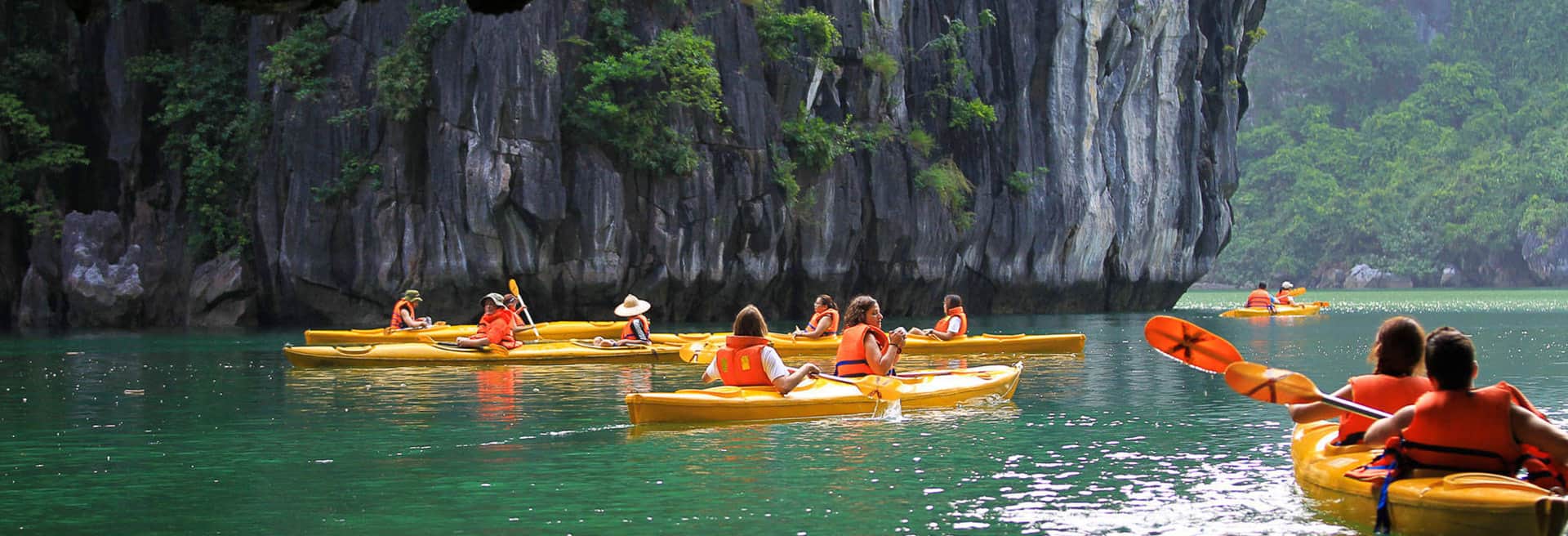
Kayaking guide in Ha Long Bay
Few experiences on earth compare to gliding silently through Ha Long Bay at dawn, your kayak cutting through jade-green water as limestone towers rise on all sides and egrets wheel overhead. A UNESCO World Heritage Site since 1994, Ha Long Bay spans nearly 1,600 square kilometres of the Gulf of Tonkin and is home to roughly 1,600 islands and islets. Kayaking lets you access what cruise decks and speedboats cannot — the narrow grottoes, secluded lagoons, and floating fishing villages that make this destination genuinely extraordinary.
Ha Long Bay's name translates as "Bay of the Descending Dragon." Local legend holds that a family of dragons sent by the gods descended here to protect Vietnam, their bodies forming the islands. Paddling among them, the myth feels entirely plausible.
When to Go: Reading the Seasons
- Best season: Oct – April (dry, cooler, calmer seas)
- Avoid: July – September (typhoon season)
- Peak months: March, April, November
- Water temp: 22–29°C year-round
The sweet spot is October through April, when northeast monsoon winds bring dry, relatively cool air and visibility is at its clearest. March and April offer warm but not oppressive temperatures — ideal for extended paddling. Summer (June–August) sees the bay alive with colour, but typhoons can develop with little notice and many kayak tours are suspended during severe weather windows.
Mornings are universally the best time to kayak. The bay is quietest before 9 a.m., the light is cinematic, and the mist that often clings to the karsts in the early hours creates an atmosphere you simply cannot photograph your way out of — you have to be there.
Choosing Your Route
Ha Long Bay's kayaking routes range from gentle 90-minute paddles for complete beginners to full-day expeditions covering 15–20 kilometres. Here are the most rewarding options, ranked by local guides:
1. Luon Cave & Surprise Lagoon — The iconic introductory route. You paddle through a low limestone archway at Luon Cave to emerge inside a hidden lagoon ringed entirely by jungle walls. Monitor lizards sun themselves on the rocks. Best at high tide when the arch is fully passable. Duration: 2–3 hours.
2. Ba Hang Floating Village — Paddle among the pearl-farming families who have lived on the water for generations. Children wave from bamboo platforms. Chickens live on boats. It is an entirely different Ha Long Bay. Duration: 2–3 hours.
3. Dark & Bright Cave (Hang Toi & Hang Sang) — Only reachable by kayak. You enter Hang Toi in pitch blackness, navigating by feel through a narrow passage before emerging into a sunlit lagoon. Bring a waterproof torch. Duration: 3–4 hours. Not suitable for claustrophobic paddlers.
4. Vung Vieng Fishing Village Circuit — A longer expedition looping around Vung Vieng, one of the bay's most photogenic floating communities. Often combined with a swim stop at a secluded beach on Hon Co Island. Duration: 4–5 hours. Recommended for experienced paddlers.
5. Lan Ha Bay Southern Loop — Technically in Lan Ha Bay (adjacent to Ha Long, equally spectacular, far less crowded). This is the local guides' personal favourite for full-day kayaking — pristine beaches, fewer tour boats, and the Cat Ba Island coastline. Duration: 6–8 hours. Requires booking a dedicated kayak guide.
"The places tourists remember most are the ones only a kayak can reach. The bay shows you a different face the quieter your vessel."
Kayak Types: What You'll Paddle
Most cruise operators on Ha Long Bay provide sit-on-top sea kayaks — stable, unsinkable, and forgiving for beginners. They typically seat two people with a shared cockpit. Solo kayaks are less common but available on request, especially with specialist kayak-tour operators.
Sit-on-top (most common)
- Very stable — great for beginners
- Easy to remount if you capsize
- Seats 1–2 paddlers
- Provided free on most cruises
- Limited speed and tracking
Sea kayak (touring)
- Faster, better tracking
- More gear storage
- Requires basic technique
- Available via specialist operators
- Ideal for full-day routes
What to Bring
Packing smart makes the difference between a memorable morning and a miserable one. Ha Long Bay's sun reflects intensely off the water, and conditions can change quickly.
| Local guide packing list: Reef-safe sunscreen (SPF 50+), a hat with a chin strap, polarised sunglasses, a dry bag for your phone and camera, water shoes or sandals with straps, at least 1.5 litres of water per person, a light rain jacket, and a small first aid kit if paddling independently. Leave jewellery and valuables on the boat. |
Safety: What the Guides Know
Ha Long Bay is generally safe for kayaking, but the bay is vast and weather can shift. Respect these guidelines that every experienced local guide follows.
 Always kayak with a guide if this is your first time. Currents between karsts can be deceptive, and the bay is large enough to disorient first-time visitors easily.
Wear your life jacket at all times. This seems obvious, but guides report that guests frequently remove them in warm weather. The rule exists regardless of your swimming ability.
Watch the tides. Some cave entrances passable at high tide become impassable or dangerous at low tide. Your guide will know the schedule — always check before entering a grotto.
Stay clear of boat traffic lanes. Commercial vessels and ferries move quickly and sit high in the water — their pilots may not see a low-profile kayak. Hug the karst edges rather than open channels.
Never kayak alone at night. After dark, navigation is extremely difficult without GPS, and the bay's boat traffic is unpredictable. Sunset paddles are magical — just return before full dark.
| Weather warning If you see the horizon darken rapidly or feel wind strengthening from the northeast, return to your mother vessel immediately. Squalls in Ha Long Bay arrive fast. Your guide will signal a return — follow their lead without question. Safety always overrides the itinerary. |
Responsible Paddling: Leave It as You Found It
Ha Long Bay faces real environmental pressure from mass tourism, and kayakers have a responsibility to protect what makes it extraordinary. Local conservation guides share these principles:
Never touch the coral formations visible in the shallower areas of Lan Ha Bay — they take decades to grow and die on contact. Don't feed the wildlife; the monkeys and monitor lizards that inhabit karst islands have become aggressive in areas where tourists have hand-fed them. Take all rubbish back to your boat — including fruit peels, which are not native to the bay's ecosystem. And consider visiting in the shoulder season, when your presence adds less to the cumulative footprint.
| Local recommendation Choose a cruise or tour operator that employs local guides from Quang Ninh province, uses kayaks without single-use plastic provisions, and participates in the bay's clean-up programmes. Several reputable operators post their environmental certifications publicly — it's worth checking before you book. |
Booking Your Kayak Experience
Most overnight cruises (the best way to experience Ha Long Bay) include one or two kayaking sessions in their itinerary at no extra cost. If kayaking is your primary reason for visiting, look for cruises that advertise it prominently and employ dedicated kayak guides rather than assigning the duty to general boat staff.
For serious paddlers or multi-day kayak expeditions — particularly around Lan Ha Bay — specialist operators based in Cat Ba Town offer guided sea kayak tours led by certified instructors. These are significantly more rewarding than the brief sit-on-top sessions offered by standard cruises, and they access areas the large cruise vessels cannot follow.
Expect to pay between $3–$8 USD per hour for kayak rental if booking independently from shore. Guided full-day expeditions typically run $35–$80 USD per person depending on group size, route, and operator quality. As with most things in Vietnam, the cheapest option is rarely the best one — the bay deserves a thoughtful experience.\
Information current as of April 2026. Always confirm weather conditions, tidal schedules, and operator safety credentials before departure. Ha Long Bay is a living, changing environment — what is true this season may differ next.
Plan your trip
Tell us about your plans and one of our specialists will plan a unique trip for you...
MAKE AN ENQUIRY