Ho Chi Minh Mausoleum Complex
Ho Chi Minh‘s Mausoleum has long been considered as the first place to come for the first time travelers to Hanoi thanks to its tremendous historical value. Everyone wants to make a pilgrimage there to show their respect for Ho Chi Minh (Uncle Ho – President Ho), the Greatest President, who led Vietnam to Independence. Being there, visitors can not only discover more about Ho Chi Minh’s life and role in Vietnamese history but also enlarge their knowledge about Vietnam’s history reflected in the complex’s components.
Ho Chi Minh Mausoleum Complex
Ho Chi Minh Mausoleum Complex is one of the most historic tourist attractions in Vietnam. Being there, travelers can learn numerous things about Uncle Ho’s life, together with the Vietnamese liberation process under his lead. For the first time traveling to this complex, people are suggested to visit:
- Ba Dinh Square (where Vietnamese First Independence Day was celebrated)
- Ho Chi Minh’s Mausoleum ( where still holds the embalmed remains of Uncle Ho),
- Ho Chi Minh Museum
- Ho Chi Minh’s House on stilts
- The Presidential Palace (White House of Vietnam)
- One Pillar Pagoda
- The House No.54 (a special historical place).
During the Vietnam war against America, the nation was divided into two parts: The North (controlled by our government) and the South ( controlled by the American one). Therefore, in that period, it was impossible for citizens living in these two parts to meet each other.
As a result, the Southern people were always looking forward to the Great Father, hoping to meet him one day. However, President Ho passed away before the country was completely united. It led to the decision of constructing that Mausoleum, which holds the remains of Ho Chi Minh, enabling everyone to come and meet him after the country became peaceful again.
In fact, when President Ho was alive, he just asked for a simple funeral, in which his dead body would be cremated and then buried in three particular parts of Vietnam.
The first part would be one area in the North, where he worked; the second one was a place in the Middle – his homeland and the last one would be in the South, in which he started his journey to discover ways to release Vietnam. Nonetheless, as Ho Chi Minh has taken an integral part in Vietnamese spirit, Vietnamese people, for the first time, did not follow his order, celebrated a national funeral and has tried to keep his body remained for years in this Mausoleum.
In order to keep Uncle Ho’s body remained for a long time, Vietnamese experts at that time had to go to the Soviet Union to learn the technology. Then, immediately after the death of Vietnam’s Great Father, these experts, together with the support of Soviet Union experts, started to embalm President Ho. After that embalming process, his body was kept in an aseptic environment in secret places, waiting for the peaceful day as well as the construction of the Mausoleum.
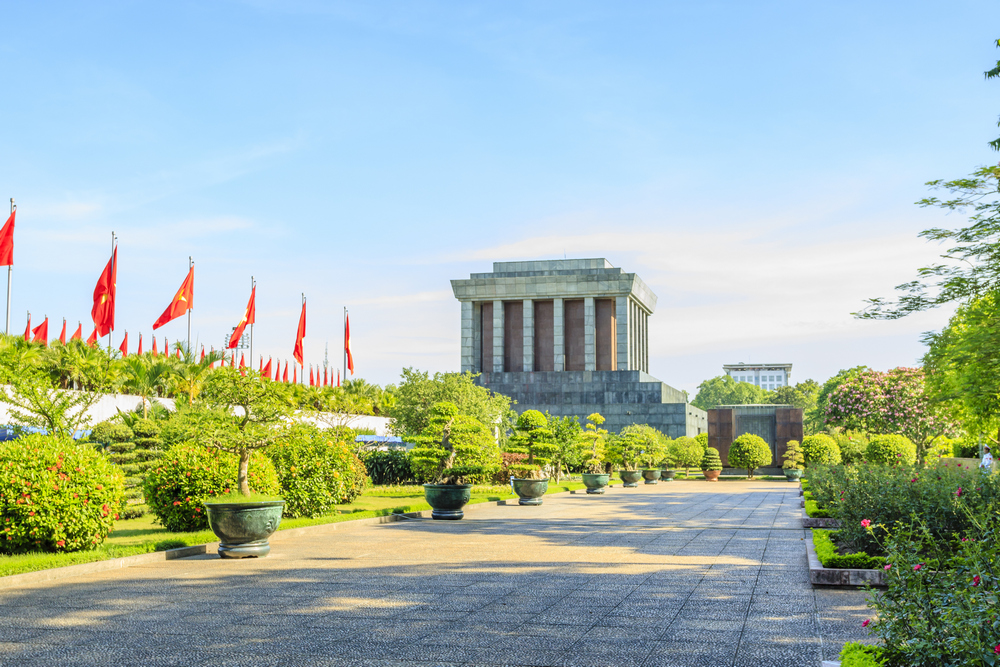
Not only with the embalming process but the Soviet Union also helped Vietnamese with building Uncle Ho Mausoleum. Ho Chi Minh Mausoleum was inspired by Lenin’s Tomb in Moscow, but the architecture was redesigned to match Vietnamese traditional culture and lifestyle.
The Mausoleum, which is surrounded by a number of marble columns, is divided into five parts. This five-part structure is to model the Vietnamese traditional house in the countryside, in which President Ho was born and brought up. On the facade of the Mausoleum, there are the words “President Ho Chi Minh” made of red plum marble, of which characters represent Uncle Ho’s lofty and morality
What makes this Mausoleum standing out is that its materials (even various plants for decoration) were from different parts of Vietnam. At that time, in order to show the whole country’s respect for President Ho Chi Minh, each province of Vietnam decided to contribute one signature material to build the Mausoleum. This action not only expresses the country’s love for the Great Father but also indicates Vietnam’s national unity.
Going inside the Mausoleum is Ho Chi Minh’s famous quote “Nothing is more precious than Freedom and Independence” made of gold. There are also two flags on the wall, one is Vietnamese national flag, one is The Communist Party flag, both of which are made of Thanh Hoa Province ’s 4000 pieces of rubies.
The embalmed body of President Ho lays on a bronze bed with lotus patterns (Vietnamese national flower), placed on a rock pedestal with automatic lift system (installed to transport Uncle Ho’s body in case of emergency). It is preserved in a glass case, put at the center of the Mausoleum, and protected by a number of military honor guards. The atmosphere here is so cool that the embalmed body of Ho Chi Minh would not be damaged.
- Location: 25 Hung Vuong, Dien Ban, Ba Dinh, Hanoi
- Opening days: Tuesday, Wednesday, Thursday, Saturday, Sunday
- Opening hours:Seasonal:
- April 1st to October 31st: 7.30 a.m – 10.30 a.m (Saturdays, Sundays and public holidays: 7.30 a.m – 11.00 a.m)
- November 1st to March 31st of next year: 8.00 a.m – 11.00 a.m
- Entrance fee: Free
- Phone: 024 3845 5128
Plan your trip
Tell us about your plans and one of our specialists will plan a unique trip for you...
MAKE AN ENQUIRY